
Holidays
Created for Thoughtful Engagement
By Holly J. Bean, PhD, LCPC, CRC, CTRS
December 13, 2020
‘Tis the season to be jolly, fa la la la la la la. However you celebrate the holiday season, the days from Thanksgiving to New Years, are typically steeped in some tradition.
Traditions are formed by many factors; cultural and ethical background, familial styles, and social norms.
Every family in the United States, and elsewhere, have their own holiday tradition. Family traditions have become just as important as the holiday itself.
But how these holidays, let alone the tradition of celebrating, came into existence is typically overlooked. In 1789, the first Federal Congress passed a resolution asking George Washington, our first President, to recommend a day of thanksgiving, Thursday, Nov. 26, 1789 was proclaimed to be the “Day of Publick Thanksgivin” (The Center for Legislative Archives, 2020). In 1863, President Abraham Lincoln created a Proclamation which dedicated the last Thursday of November as the official date for Thanksgiving. However, Thanksgiving was moved to the third Thursday in November by President Franklin Roosevelt in 1939, in order to increase the shopping season of Christmas and assist with the economic recovery (The Center for Legislative Archives, 2020). Perhaps it is FDR we should thank for Black Friday?
The day after Thanksgiving, known as Black Friday, actually earned that moniker in September of 1869, after the stock market crashed due to two unscrupulous men trying to corner the gold market (History, n.d.). During the 1950’s the term Black Friday was reintroduced by the Philadelphia police on the day after Thanksgiving and the day before the Army-Navy Saturday game. The throngs of people coming into their city for the football game caused the police force to work over-time and deal with unruly people (History, n.d.). As the day after Thanksgiving became more and more a retail celebration, the name Black Friday stuck, even as retailers worked to change it to something less negative.
The citizens of the United States did not typically observe Christmas until the mid-1800s, when the Washing Irving fictional story telling of Christmas being celebrated in England ignited the tradition. Immigrants brought their cultural celebrations regarding Christmas, such as the German’s who brought with them the practice of placing evergreen branches and trees in home during winter as a reminder of life during hard times. Nativity scenes were shared by the Catholic immigrants, the tradition started by Saint Francis of keeping small nativity scenes in their homes. It wasn’t until the late 1800s that most Americans began celebrating Christmas. In 1870, President Grant and Congress declared Christmas, the celebration of the birth of Jesus Christ, savior of the world, a federal holiday (The Classical Historian, 2015). Christians continue celebrating the birth of Jesus Christ on December 25th, and have assimilated various cultural traditions into their celebration.
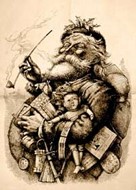
Early Dutch settlers brought into the new world (America) their cultural heritage of St. Nicholas and Kris Kringle, which later became SinterKlass, or as we say ‘Santa Claus’ (WhyChristmas.com, n.d.).
In 1823 the famous poem ‘A Visit from St. Nicholas’ or ‘T’was the Night before Christmas’, was published. Dr. Clement Clarke Moore, long credited as the author, noted he had written it for his children. The poem describes St. Nicholas with eight reindeer and gives them their names, which were popularized in the song ‘Rudolph the Red nosed Reindeer’, written much later in 1949 (WhyChristmas.com). St. Nicholas established the tradition of gift giving and taking care of the poor or those less fortunate. Finland’s cultural tradition provided the reindeer and the sleigh which remain in our current view of Santa Claus.
Charles Dickens, the English author, is probably most recognized for his fictional account of Mr. Scrooge in the story titled A Christmas Carol, published in 1843, bringing the meaning of Christmas to the forefront (Charlesdickensinfo.com, 2020).
A letter written by an 8-yr old girl was answered by the Sun Newspaper in 1897. ‘Yes Virginia there is a Santa Claus’ was the response given to the little girl on the perennial question that even children today continue to ask.
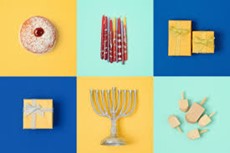
Hanukkah, the Jewish holiday that takes place during December, is a celebration of triumph over oppression. Jews, including the Maccabee’s, were fighting against Antiochus IV Epiphanes, the King of Syria around 168 B.C. King Antiochus outlawed the Jewish faith and demanded all Jews worship the Greek Gods. The King’s soldiers desecrated the Holy Temple and created an altar to Zeus where pigs were sacrificed (History.com, n.d.). History.com continues with
According to the Talmud, one of Judaism’s most central texts, Judah Maccabee and the other Jews who took part in the rededication of the Second Temple witnessed what they believed to be a miracle. Even though there was only enough untainted olive oil to keep the menorah’s candles burning for a single day, the flames continued flickering for eight nights, leaving them time to find a fresh supply. This wondrous event inspired the Jewish sages to proclaim a yearly eight-day festival. The first Book of the Maccabees tells another version of the story, describing an eight-day celebration that followed the rededication but making no reference to the miracle of the oil (History.com, n.d.).
According to tradition, each night during Hanukkah, one additional candle is lit by the shamash (the lit candle used to light each subsequent candle) until all eight candles are lit together on the final night of the festival. More Hanukkah festivities include playing the game of dreidel and eating oil-based foods, such as latkes and sufganiyot (in honor of the miracle of the oil), and dairy foods. Gift giving has been introduced most recently (History.com, n.d.).
The Hanukkah celebration revolves around the kindling of a nine-branched menorah, known in Hebrew as the hanukiah. On each of the holiday’s eight nights, another candle is added to the menorah after sundown; the ninth candle, called the shamash (“helper”), is used to light the others. Jews typically recite blessings during this ritual and display the menorah prominently in a window as a reminder to others of the miracle that inspired the holiday. Hanukkah customs include playing with four-sided spinning tops called dreidels and exchanging gifts. In recent decades Hanukkah, similar to Christmas, has exploded into a major commercial phenomenon (History.com, n.d.).
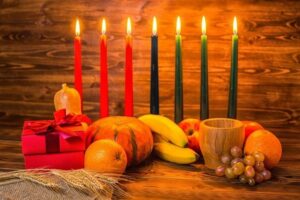
A relatively newer holiday tradition saw its inception in 1966. Kwanzaa (pronounced Quanzi) is a weeklong celebration honoring African heritage in the African-American culture. This holiday is observed from December 26th to January 1st. Dr. Maulana Karenga, professor and chairman of Africana Studies at California State University, created this holiday as a response to the Watts Riots in Los Angeles in 1965 (History.com). It was through research on African celebrations that Dr. Karenga created this holiday, in hopes to bring the African-American community together. Kwanzaa is Swahili for harvest or first fruits (History.com). The celebration combines drumming, dancing, singing, poetry reading, and feasting (History.com, n.d.).
Dr. Karenga designed Kwanzaa to follow seven guiding principles. These principles represent the values of African culture that help to build and reinforce community. Similar to Hanukkah, Kwanzaa uses a daily candle lighting ritual to share these principles. After all candles are lit and the seven principles shared, a feast called karanu, is shared by all (History.com, n.d.).
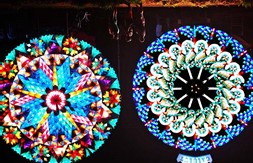
Other holiday traditions observed around the world include the Giant Lantern Festival in the Philippines where every year on the Saturday before Christmas giant lanterns are created with intricate, kaleidoscope designs (Momondo, 2017).
Krampus is celebrated in Austria. Krampus is the polar opposite of St. Nicholas and is responsible for dealing with the “naughty” children. Krampus has somewhat of a demonic look and is to be feared, yet he seems to have found his place in their culture (Momondo, 2017).

However your family has created its holiday tradition, Thoughtful Engagement wishes you much joy, love, and good health during this and every holiday season.
References
https://www.archives.gov/legislative
https://www.charlesdickensinfo.com/christmas-carol
https://www.classicalhistorian.com/johns-blog/a-history-of-christmas-in-america
https://www.history.com/topics/holidays/hanukkah
https://www.newseum.org/exhibits/online/yes-virginia-there-is-a-santa-claus/