
Validating Our Loved Ones
By Holly J. Bean, PhD, LCPC, CRC, CTRS
How often have we heard our loved ones diagnosed with cognitive impairment say something that makes no sense or is not based in what we feel is reality? Perhaps you have heard them say something that has come out of left field that completely surprised you? My mother, diagnosed with mild cognitive impairment, had created a completely different story of her youth than her actual experience. Her fantasy was much nicer and made her smile when she told it. Instead of countering her new memory, I listened. Why would I want to create dissonance by telling her that it never happened? Her false memory makes her happy and I want to support her happiness.
When working as an Elder Life Specialist in the geriatric department of a hospital, I spent many hours assessing patients to ascertain their cognitive baseline with the goal of reducing any type of decline while hospitalized. Initially, I would include the family members in the assessment process, if they were present. The clinical judgement for this decision focused on how important family members who visited were to the vulnerable adults. However, this decision quickly was reversed. Family members love their hospitalized older adult. They truly do. Yet, the education of what cognitive decline is, how it presents, and ultimately what our loved ones struggle with is not often well known or understood by the family. Family would like their loved one to be the same person they have always been. A grown child may still see their parent as the strong, intelligent, wise, and (fill in the blank) person they always were. During the assessment, orientation questions are asked, such as the date, day of the week, year, location of the hospital, etc. When the family members who were present for the assessment heard their loved one say the wrong date or any incorrect answer, they inevitably became very upset and demanded that the loved one must know the answer, and they would tell their loved one to think or try harder.
It became apparent to me that education was necessary. Education for the caregivers, for family members, for those who believe that the use reality therapy helps our vulnerable older adults. Reality therapy does not work. Reality therapy creates dis-ease, dis-harmony, and can add to agitation. Reality therapy demands that others join us in our own limited view of what reality is. It is when we become curious to learn more about the new world our loved one is inhabiting that we can offer a bridge of compassion. I do understand that this can be a bit intimidating, even somewhat scary. Yet, the bridge offers us the opportunity to get to know and perhaps fall in love, with our loved one all over again.
My mother’s childhood was difficult. Her mother died when she was 8 years old. No one talked to her about her mother’s death. Her father’s work took him away from home for long periods of time. He was pivotal in laying the cable between the U.S. and Britain during the WWII. My mother and her younger brother were raised by a very stern, exhausted grandmother who had lost two daughters and her own husband. It makes perfect sense to me that my mother would rewrite her early history into something much more loving and kind. In her new and revised memories, my mother worked at a large, well known restaurant in New York City, where her father would come in and order his meals from her. With pride she would wait on her father and in return he would leave her a large tip, letting her know how proud he was of her. This new memory gave her tremendous happiness.
Validation therapy is the technique that I utilized with my patients in the hospital. It was reasonable that I treat my mother with the same kindness. Validation therapy does not ask the caregiver or family member to correct every wrong statement a loved one makes, it asks us to validate where they are in their progression of the disease. It is a kind and mindful way to communicate with our loved one on their own terms. We may forget to truly listen to the other person, mindfully, which means without judgement while being present. Utilizing Validation therapy is simple – it is the ability to join your loved one wherever and whatever they are experiencing with empathy, being genuine, and offering nonjudgmental listening (Feil, 1993). I would add to be curious enough to ask questions – questions that allow our loved ones to expound upon the new memory in a helpful way. In my mother’s example as a waitress (she never worked as a waitress), I asked her questions on how it felt to wait on her father and have him visit her at work (again, this never happened). She would beam and share that it made her realize that he loved her. I validated her experience of needing her father’s love and in her false memory, she received it. Validation therapy is not about anyone other than our loved one.
You will notice that validation therapy contains elements of improvisation. Dr. Jade Angelica writes about this technique in her book Where Two Worlds Touch (Angelica, 2014). She uses this technique when speaking with her mother, who is in a nursing home due to dementia. Improvisation asks the caregiver to join the loved on in whatever situation they find themselves in, without regard to truth or fact. This has proven to be somewhat of a struggle for some, as they feel they are being dishonest.
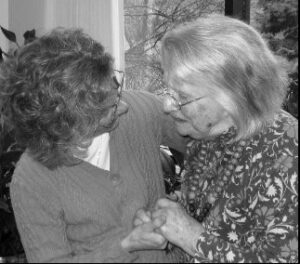
Validation therapy may be the tool that allows us to feel less dishonest while meeting our loved one’s needs. The task is to use non-threatening factual words to build trust (Feil, 1993). It is the caregiver’s main job to avoid asking questions that force our loved one with cognitive impairment to face their deficiency. Instead the caregiver can ask who, what, where, when and how questions. As an example, an older adult with cognitive impairment believes that jewelry is being stolen. The caregiver may ask the older adult who they feel is taking the jewelry (instead of telling the woman that no one is taking the jewelry). The next question may consist of what jewelry is being taken (notice I am using the same words the older woman used). Once I learn what the older adult feels was taken, I can then lead the conversation into a new direction: reminiscing. I might say, “That was your favorite necklace, wasn’t it? Who gave you that necklace?” Not once did I try to demand that the older adult join me in my reality that the necklace was not taken. Instead, I asked validating questions, which reduced the older adults anger and led us into the realm of reminiscing, redirecting her focus. While my older adult was speaking, I maintained eye contact and genuinely listened. I used her own wording, which also validates.
When in an emotional situation, we tend to model each other. If my client or loved one is upset, I may begin to get upset, especially if I were to use reality therapy. Yet, just the opposite is also appropriate: if I remain calm, my client may remain calm by validating the client or loved one. I much prefer to have my client model calmness. Taking a deep breath, speaking slowly, and maintaining a calm demeanor can go a long way in helping to ease any distress our client or loved one might be experiencing.
Remember, all behavior is communication. Validating the behavior and the communication that can help the situation is kindness.
References
Angelica, J. (2014). Where Two Worlds Touch. Boston: Skinner House Books
Feil, N. (n.d.). Validation Therapy Connecting Heart to Heart with Older Adults. Retrieved from https://vfvalidation.org/